
Fingerspitzengefühl
What Sam Walton knew about staying close to the market — and why most leaders stop doing it.

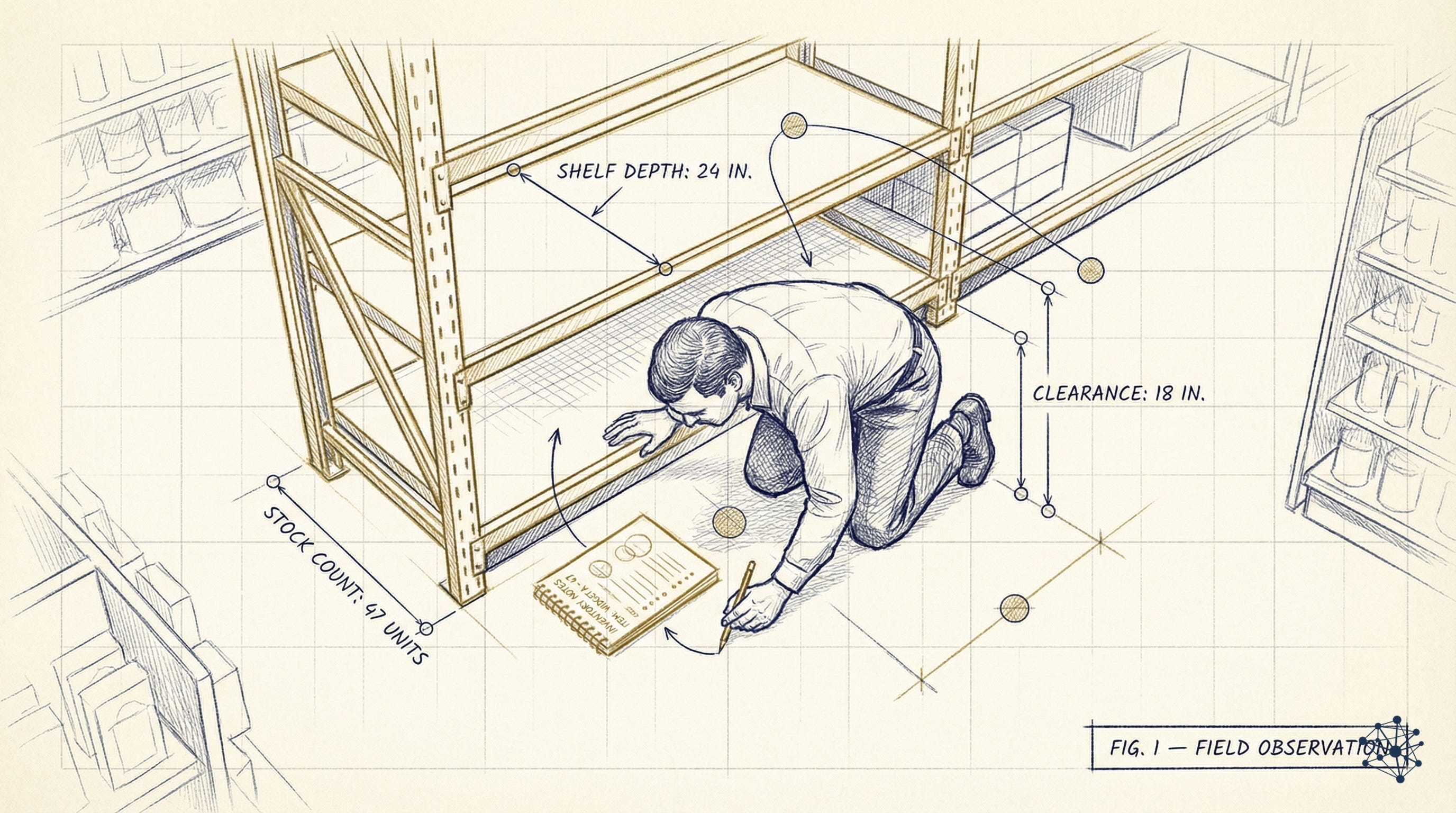
Sam Walton, the Walmart founder and long-time CEO, made a habit of walking through Kmarts, spiral notebook in hand, furiously jotting down anything that caught his attention. In Made in America, his 1992 autobiography, he tells the story of a competitor catching him on his hands and knees, under a table in their store counting through the inventory while grilling a sales clerk on how she knew what to re-order and how often. The manager recognized him and asked what he was doing. Walton looked up from the floor. "Oh, this is just part of the educational process."
The book is full of moments like this. Walton showing up unannounced in his own stores, in competitors' stores, in the headquarters of rival chains where he'd walk in and introduce himself as "Sam Walton from Bentonville, Arkansas" and ask if he could look around. Most of them rewarded his boldness, inexplicably letting him in. He'd been doing it since he opened his first variety store in 1945, and he kept doing it for the rest of his life.
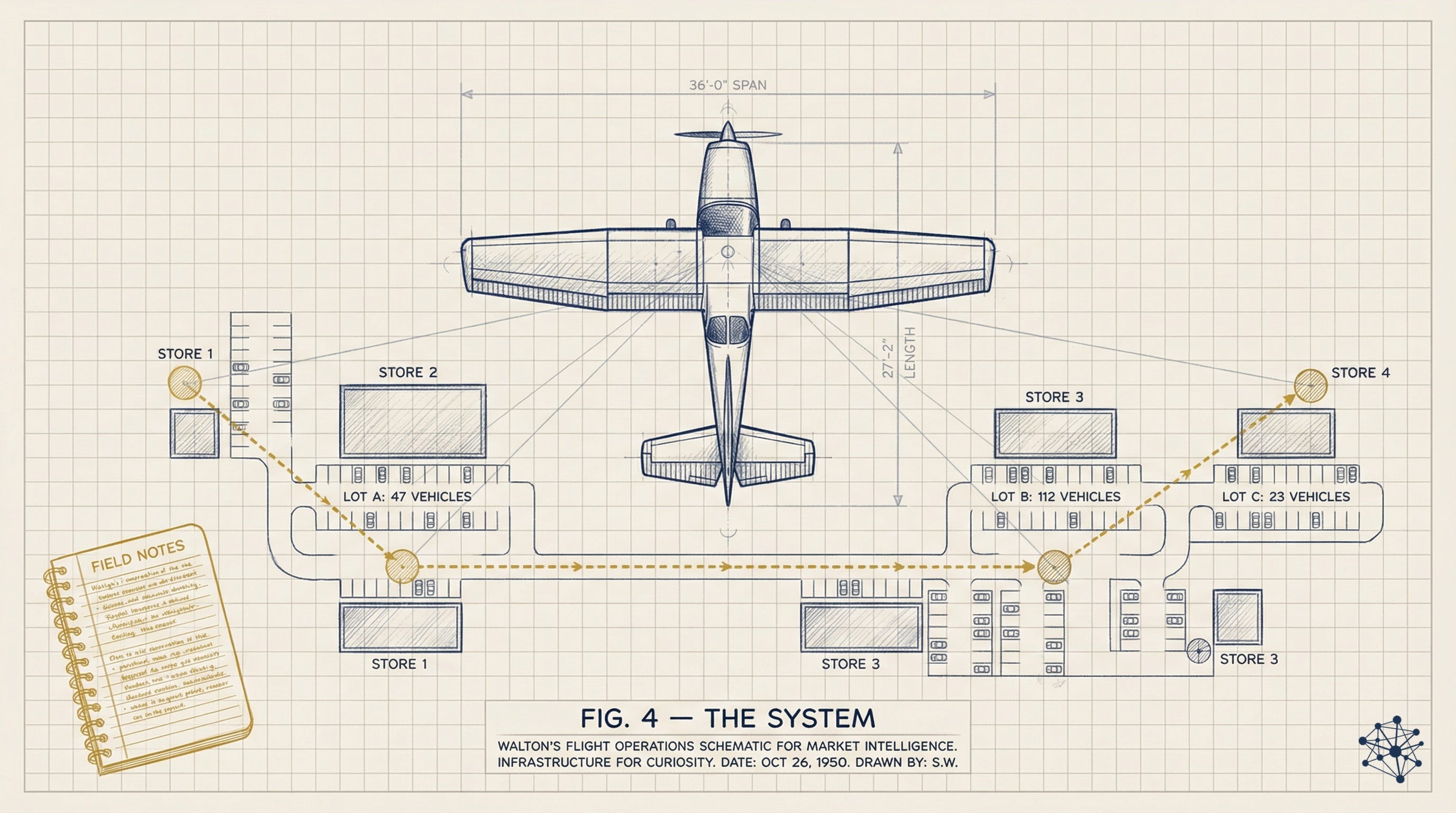
What stands out reading the book today isn't any single visit. It's the system Walton built to make sure the visits kept happening. He flew his own Cessna between locations, inspecting the number of cars in Walmart parking lots from the air before he landed to walk the floors, always carrying that notebook, asking questions of customers and employees, constantly making lists of what he observed and thought the company should improve on.
He'd bring the lists back to Bentonville to review with his leadership team at their standing Saturday morning meetings. That's where the decisions got made, and Walton insisted the inputs come directly from the stores, not from summaries of summaries filtered through regional managers. The people on the front lines, he said, are the only ones who really know what's going on out there. A computer is not a substitute for getting out in your stores and learning from your customer.
Even after he stepped down as CEO in 1988, he kept flying store to store, kept talking to Walmart associates. He never stopped.
He was the richest person in America. He was running one of the largest companies in the world, with thousands of stores, and plenty of IT systems to bring reports back to the home office. So why did he keep crawling around the floor of a competitor’s store, scribbling in that notebook?
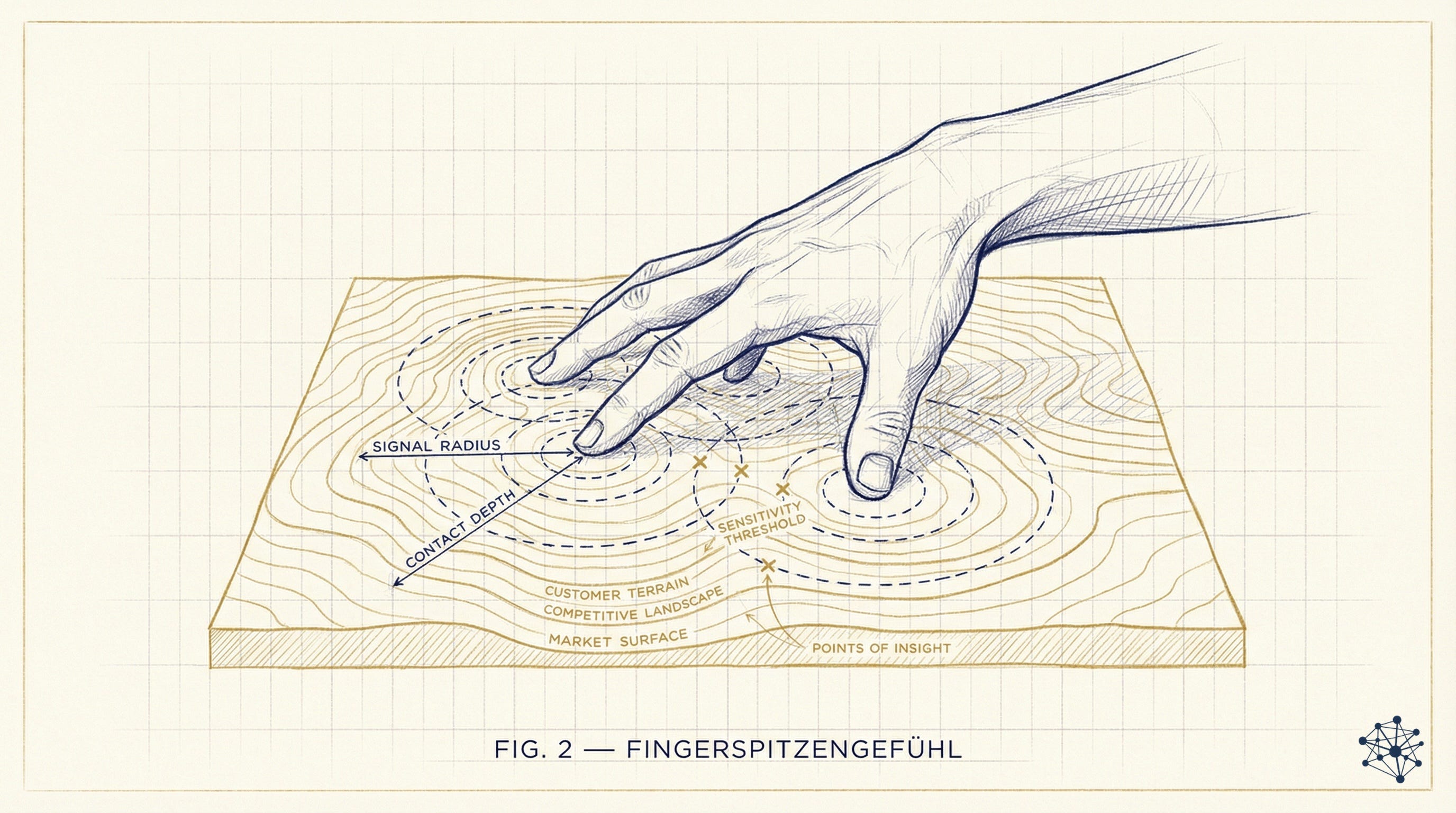
The German language has some truly great words. The most inventive is probably backpfeifengesicht or “face in need of a smack.” Though I struggle to pronounce it, fingerspitzengefühl is my favorite — literally "fingertip feeling." Three German words compressed into one: Finger, Spitzen, Gefühl. Feeling at the tips of the fingers. It’s perfect for what Walton was doing.
The term comes from the German military, where it described something more specific than instinct. A commander with fingerspitzengefühl could hold a map of the battlefield in his mind and update it continuously as new information arrived — not through formal reports or structured briefings, but through direct contact with what was happening on the ground. During World War II, Field Marshal Erwin Rommel was said to have it while directing tank battles in North Africa. The British soldiers he outmaneuvered attributed an almost mystical quality to his decision-making. But it wasn't supernatural. It was the product of relentless, firsthand observation fed into a mental picture that never stopped adjusting. The battlefield wasn't something he studied from a distance. He was inside it, and the feel he developed there let him act before his opponents understood what they were seeing.
I came across the concept while studying John Boyd's OODA loop — the Observe, Orient, Decide, Act cycle that Boyd developed from his experience as a fighter pilot and that became the foundation of my own market discovery work. Boyd encountered the term in a debriefing with a German pilot in the late 1970s and recognized it immediately as the thing that made his decision framework function at speed: the intuitive feel that lets you skip the slow, explicit steps and move straight from observation to action.
But you don't need Boyd's framework to understand what fingerspitzengefühl means. You've felt it yourself. It's the sense you develop for a market or a customer when you've spent enough time in direct contact with them that you start to know things before the data confirms it. Not because you're guessing, but because you've absorbed enough raw signal that your picture of what's happening updates itself almost automatically.
For a product owner, fingertip feel isn’t flying a Cessna to retail stores. It’s the knowledge you get from sitting across the table from a customer whose body language betrays his frustration as he describes what your platform should be doing. It’s what you pick up in the fifteen minutes after a demo when the prospect relaxes and starts talking about what they actually need instead of what they told procurement they needed. It’s the pattern you start to notice after your eighth or ninth conversation with an operations director who’s been burned by a competitor’s implementation. That kind of knowledge doesn’t survive summarization. You can’t get it from a dashboard, and you can’t get it from a report your team prepared for you. You have to be in the room.
Walton was in the room every week for forty-seven years. He didn’t have fingertip feel because he was Sam Walton. He had it because he built a system that kept him in contact with the market and he never let anything pull him away from it.
Early in my career I had the great fortune to work with a product leader who taught me a phrase that would become my mantra: “get out of the office.” The people who know what’s happening in the market are not in our building, he would say. They’re in theirs. Go see them and listen.
He would be the first into the field when there was a chance to meet customers, and he was the best at asking questions that opened them up. He built great products using this approach. And yet over the years, I watched as he stopped doing it almost entirely.
Not all at once. Nobody wakes up one morning and just quits a behavior that had served them so well. What happens is that the calendar fills. A leadership offsite needs preparation. A board meeting requires a dry run. A reorganization is taking shape and if you're not in the room when the decisions get made, you may not like what you come back to. Every one of those choices is rational on its own. The problem is that they compound, and somewhere in the accumulation, “get out of the office” get lost in the priority shuffle.
He didn't become less capable. He became less available, and then less curious, and eventually less connected to the market he'd once known better than anyone in the org. The institution didn't take his fingertip feel away. He traded it, one reasonable calendar decision at a time, for proximity to the people making decisions inside our building.
It’s easy to hear the Sam Walton story and dismiss it, to think he was the boss and had nothing at risk. Of course he could spend time out in the market. Nobody in Bentonville was going to outmaneuver him for a promotion while he was on the floor of a Kmart, counting through its inventory. He didn’t have to worry about losing his seat at the table because he owned the table.
But the demands on his time — from his board, Wall Street analysts, his direct reports — would have made it easy to rationalize giving up these trips. The gravitational pull of the office gets stronger the closer you are to its center. Most leaders end up relying on feedback filtered through other people's hands, whether that's their sales teams, analyst reports, or metrics fed into dashboards. What made Walton unusual was that he refused to outsource market contact to others. He knew that the Fingerspitzengefühl, the fingertip feel he got from being out in the field, gave him an intuition about his customers that he couldn't get any other way. An intuition he needed to keep the rest of his massive organization pointed in the right direction.
So he made getting out of the office a priority.
He made a choice.
That meant Walton was really no different than any of us. He faced the same pull inward. He just refused to give in to it. And so he kept flying the Cessna and landing unannounced, kept pulling out the spiral notebook and writing down what he heard from the people who were closest to the customer. Not because it was easy, but because he made the decision to give it priority.