
A Self-Training Plan for AI
(For Students — Or Anyone Looking to Jump In)

A note before we start. I wrote the plan below for a class of high school juniors and seniors at Cardinal Gibbons High School in Raleigh, North Carolina. I was there to talk about what I’ve seen AI do to the startup economy, and to make a case that the skills school rewards most heavily are, uncomfortably, the skills AI replaces most easily. That’s an argument I’m developing more fully in an upcoming essay called “The Achievement Trap,” which I’ll publish here soon.
But the training plan came out of a simpler question a student could reasonably ask after hearing all of that: Okay, so what do I actually do?
What follows is my answer. It’s written for 17-year-olds, but the truth is, the same plan applies to anyone who’s been circling AI without committing — using it occasionally, maybe impressed, maybe skeptical, but not yet changed by it. The age doesn’t matter. The willingness to be awkward and uncomfortable for a while does.
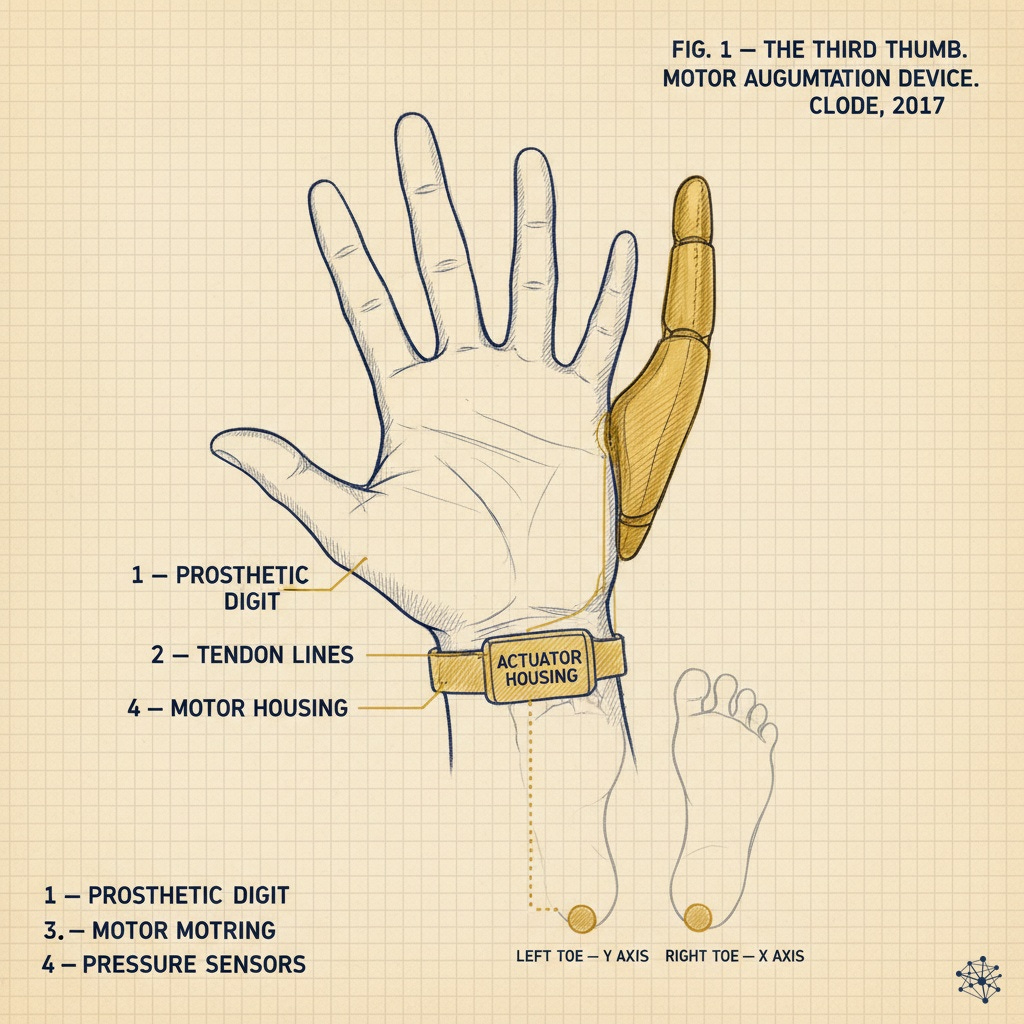
In 2017, a designer named Dani Clode built a robotic thumb. It straps to the outside of your hand, opposite the pinky, and you control it with pressure sensors under your toes. The hardware is clever, but the breakthrough was what happened inside people’s heads.
Researchers at UCL and Cambridge put the Third Thumb on participants for five days. Brain scans before and after showed something remarkable: the mind’s representation of the hand had changed. The motor cortex had reorganized itself to treat the prosthetic as part of the body. Participants weren’t using the thumb anymore. They were thinking with it—reaching for objects in ways they never had before, developing entirely new movement patterns that integrated the extra digit into their natural grip.
Here’s why that matters for you: it didn’t happen on day one. On day one, the Third Thumb felt weird. People’s existing hand movements got worse before they got better. The brain had to break old patterns before it could build new ones.
AI is a cognitive prosthetic. A brain that sits outside the body that, if you can figure out how to use it, force multiplies what you can get done intellectually, creatively, productively.
Right now, most people are stuck on day one.
Here’s what I mean. You have access to AI. So does everyone else. Your school might block it, your teachers might be debating it, but the tools are free and available on your phone right now. Access is not the problem.
The problem is integration. The difference between someone who uses AI and someone who thinks with AI is the same difference the Third Thumb researchers found: it’s neurological. The people who get real value from AI have rewired the way they approach problems. They instinctively know when to hand something to the AI and when to do it themselves. They can feel when the AI is wrong the way you can feel when a sentence sounds off, even if you can’t name the grammar rule. That instinct doesn’t come from watching a tutorial. It comes from hundreds of hours of practice.
I run an investment fund that backs technology startups. I’ve watched a dozen portfolio companies navigate the AI transition in real time. The pattern is consistent: the people who thrive aren’t the ones with the best prompting tricks. They’re the ones who’ve integrated AI deeply enough that it changed how they think about their work. One company’s CTOs says he doesn’t write code anymore—he spends his time deciding what to build. The AI handles the how. But he only got there after months of clumsy, frustrating practice where the AI produced garbage and he had to figure out why.
Nobody skips that phase. Not him, not me, not you.
What follows is a plan. It’s organized in three phases, not because I love frameworks, but because the Third Thumb research suggests the brain actually does rewire in stages—disruption, then expansion, then integration. Each phase feels different. Each one is uncomfortable in its own way.
A few things before you start. First, this plan assumes you’ll use Claude (claude.ai—it’s free), but any capable AI will work. Second, I’m not going to tell you this will be fun. Some of it will be. Some of it will feel like trying to write with your non-dominant hand. That awkwardness is the point—it’s the signal that your brain is reorganizing. Third, this is not a class. Nobody is going to assign this to you. Nobody is going to grade it. If that bothers you, you might want to sit with why.
Phase 1: Wear It Everywhere (Weeks 1–4)
The goal here is not mastery. It’s not even competence. The goal is instinct—building the reflex to reach for AI the way you reach for your phone when you need directions. You’re not trying to get good at prompting. You’re trying to break the habit of doing everything in your own head.
For 30 days, use AI for everything. Homework, research, studying for tests, planning your weekend, arguing with yourself about what college major makes sense, figuring out how a car engine works because you got curious. Everything. When you catch yourself staring at a blank page or a problem set, open Claude first. Ask it to help you think. Ask it to explain something you don’t understand. Ask it to argue against your position.
Keep a simple log—even a notes file on your phone. Not a journal. Just a running list: what you tried, what worked, what didn’t. You’ll start noticing patterns in the first week. The log is how you accelerate them.
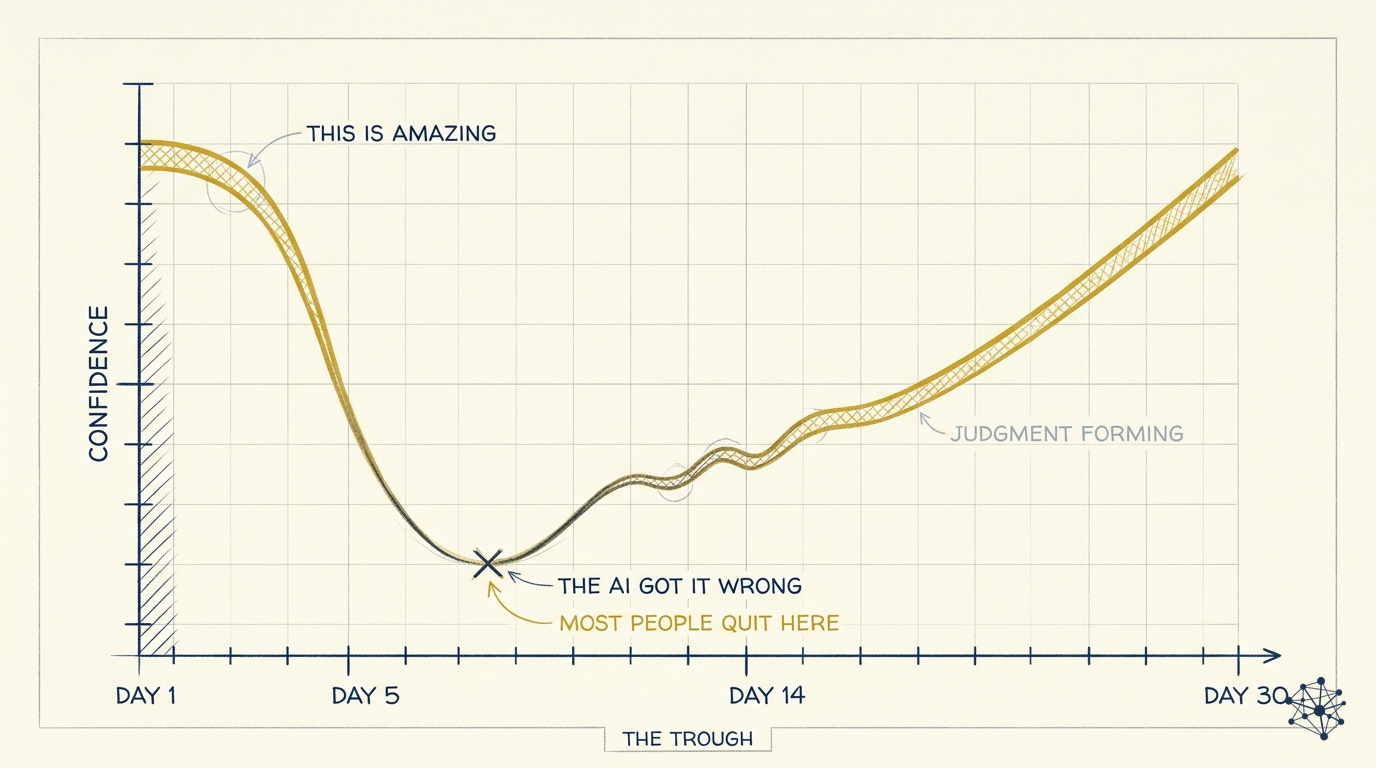
Here’s what will probably happen. The first few days, you’ll be impressed. The AI will write something decent and you’ll think, this is amazing. Then, around day five or six, you’ll hit the trough. The AI will get something wrong—confidently, convincingly wrong—and you’ll realize you almost handed in garbage. That trough is important. It’s where you start developing judgment. The people who quit here are the ones who never build the instinct.
If you want structured support during this phase, Anthropic (the company that makes Claude) has a free course called AI Fluency for Students. (All links are at the bottom of this essay.) It’s practical and well-built…not theoretical, not a lecture on ethics, but actual practice using AI as a thinking partner. Ethan Mollick’s Substack, One Useful Thing, is also worth reading. Mollick is a Wharton professor who’s been writing about AI and education more clearly than anyone I’ve found. Start with his recent posts on how students are actually using AI—they’ll make you feel less alone in the awkward phase.
Phase 2: Do Things You Couldn’t Do Before (Months 2–6)
Phase 1 is about using AI for tasks you already know how to do. Phase 2 is where it gets interesting. This is the expansion phase—you start using AI to do things that were previously impossible for you.
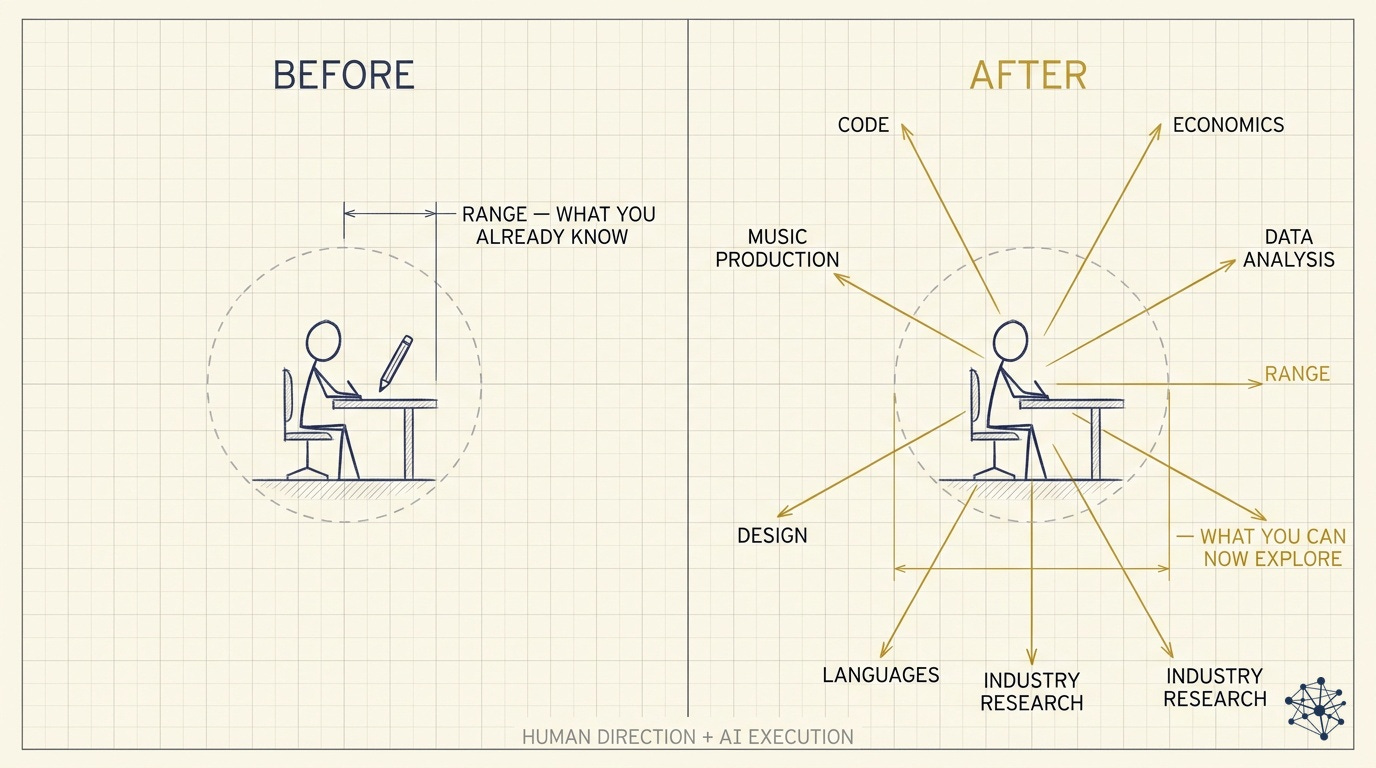
Can’t code? Build a website anyway. Use Claude to write the code while you make the design decisions and tell it what you want. You’ll learn more about how software works in a weekend than most intro courses teach in a semester, because you’ll be building something real and running into real problems.
Always been curious about economics but never taken a class? Have Claude simulate a Socratic dialogue where it plays a skeptical economics professor and you defend a position on, say, whether raising the minimum wage helps or hurts workers. It’ll push back. You push back harder. Then ask it to grade your argument and tell you where the weaknesses are.
Want to understand how a specific industry works? Pick one of your parents’ jobs, or a career you’re considering, and have Claude walk you through a typical week in that role—the actual problems people solve, the decisions they make, the skills that matter. Then ask it what parts of that job AI is most likely to change in the next five years. The answer will be more honest than anything you’ll hear in a career day assembly.
The principle here is simple: the AI handles execution so you can focus on direction. You decide what to explore. The AI helps you get there faster than you could alone. That combination—human direction, AI execution—is the skill set companies are already paying a premium for. Every month you spend developing it puts you further ahead.
Two resources for this phase. Google’s AI Essentials course on Google Skills is free and walks through practical AI applications across different kinds of work—it’s a good way to see what’s possible beyond homework help. Harvard’s CS50 Introduction to AI is free on edX and goes deeper into how AI actually works under the hood. CS50 requires some Python, but if you did Phase 1 well, you can use Claude to help you learn Python as you go. That’s the whole point.
Phase 3: Build Something Real (Months 6–18)
This is the integration phase. The Third Thumb researchers found that after enough practice, participants didn’t think about the prosthetic anymore. It was just part of how they moved. Phase 3 is where AI becomes part of how you think.
Pick a real problem. Not a homework assignment. Not a hypothetical. Something you’ve actually noticed in your school, your neighborhood, your family, your job if you have one. Maybe the school’s club signup process is a mess every fall. Maybe your parents’ small business does something manually that could be automated. Maybe there’s a community issue you’ve been complaining about and nobody’s fixing.
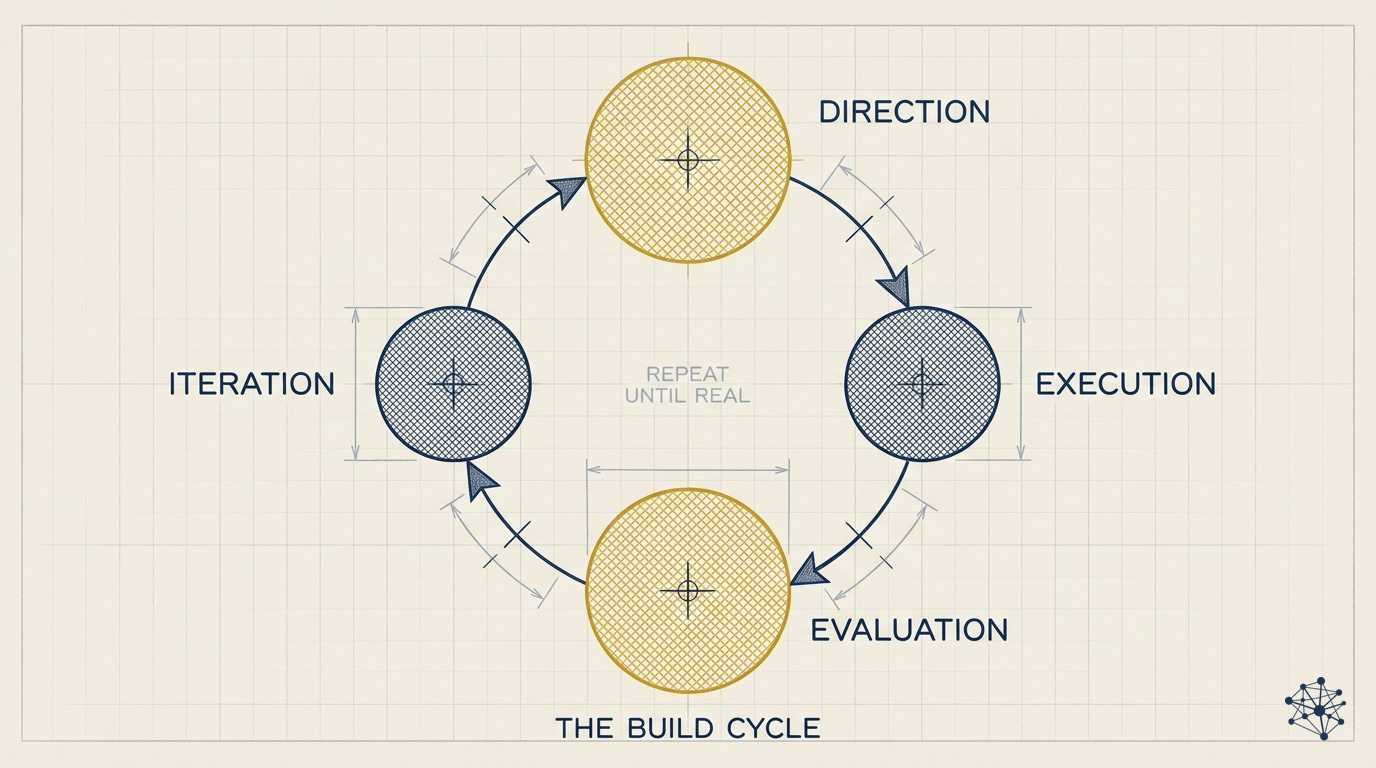
Now build something. A prototype, an app, a detailed proposal with data, a working tool. Use AI as your co-builder. You make the decisions about what’s worth building and who it’s for. The AI helps you build it. When the AI gets something wrong—and it will—you figure out why and fix it. When you hit a wall, you rethink the approach. That cycle of direction, execution, evaluation, and iteration is the most valuable skill in the modern economy, and it’s nearly impossible to teach in a classroom. You have to do it.
This is where you’ll discover something the Third Thumb researchers also found: the prosthetic doesn’t just add capability. It changes how you see problems. People with the Third Thumb started noticing opportunities to pick things up in ways they’d never considered before. The extra digit didn’t just help them do old things better—it opened up possibilities they hadn’t imagined. AI does the same thing to your thinking, but only if you’ve put in the months of practice to get there.
For this phase, Ethan Mollick’s book Co-Intelligence (2024) is the best single resource I’ve found on thinking about AI as a true collaborator rather than a fancy search engine. If you want to build software specifically, Claude Code lets you build full applications from the command line—it’s the tool I demonstrated to your class, the one that built a working web app during the presentation. And if you want community, Anthropic is building Claude Builder Clubs on college campuses that are expanding to high schools. Find one, or start one.
I want to be honest about what this plan doesn’t solve. It doesn’t tell you what career to pursue. It doesn’t make the uncertainty of the next decade less real. The economy is reorganizing around AI in ways that nobody—not me, not your teachers, not the experts on cable news—fully understands yet.
What the plan does is put you in a position where uncertainty is an advantage rather than a threat. The people who’ve integrated AI into their thinking are the ones who can adapt when things change, because they’ve already practiced the hardest part: being bad at something new and sticking with it until it clicks.
That’s what the Third Thumb teaches us. The prosthetic is available to everyone. But the rewiring—the part that actually matters—is something you have to do yourself.
Nobody can assign it to you. And nobody can do it for you.
Where to Start (Right Now)
Sign up for a free Claude account at claude.ai. Use it for your next assignment. Not to write the assignment for you—to think through it with you. Ask it to challenge your ideas. Ask it to explain what you don’t understand. Ask it where your argument is weakest.
Do that every day for 30 days. Then come back and read this again.
You’ll be surprised how different it sounds.
Resources Referenced in This Post
Phase 1: Claude (claude.ai) · Anthropic’s AI Fluency for Students course (anthropic.skilljar.com) · Ethan Mollick’s One Useful Thing Substack (https://www.oneusefulthing.org/)
Phase 2: Google AI Essentials (skills.google) · Harvard CS50 Introduction to AI (cs50.harvard.edu/ai, free on edX)
Phase 3: Co-Intelligence by Ethan Mollick (2024) · Claude Code (anthropic.com) · Anthropic Claude Builder Clubs
The Research: Dani Clode’s Third Thumb Project · UCL and Cambridge motor augmentation studies